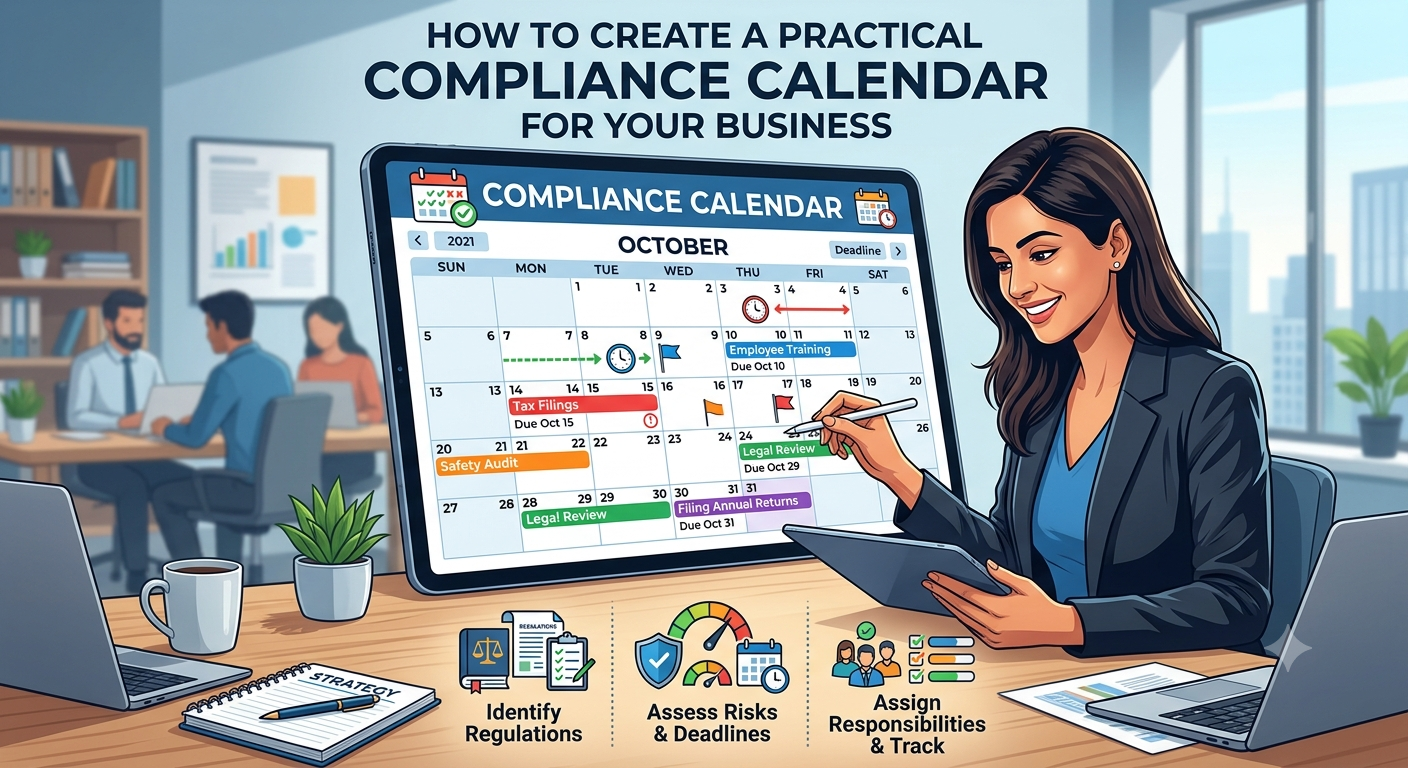
Managing business compliance becomes easier when important responsibilities are planned in advance. Businesses need to keep track of tax filings, financial records, statutory obligations, licence renewals, and other requirements that apply to their operations. Without a clear schedule, it can be difficult to remember deadlines, coordinate with employees, and prepare the necessary documents on time.
A practical compliance calendar helps business owners organise these responsibilities throughout the year. Instead of managing every task at the last minute, businesses can follow a structured process that supports better planning, recordkeeping, and accountability.
1. Identify the Compliance Requirements for Your Business
The first step is to understand which compliance requirements apply to your business. These can vary depending on the legal structure, industry, location, employee strength, turnover, and nature of business activities.
For example, a company may have corporate filing and board-related obligations, while a GST-registered business may need to manage applicable GST returns and tax payments. Businesses with employees may also have specific payroll and employment-related compliance responsibilities.
Prepare a list of applicable requirements rather than copying a generic calendar from another business. Verify the relevant obligations using official sources or appropriate professional guidance.
2. Organise Compliance Tasks by Category
Once you identify the requirements, group them into categories. This makes the calendar easier to understand and helps different team members focus on their responsibilities.
Common categories include:
- Tax compliance: Applicable GST returns, income tax obligations, tax payments, and related documentation.
- Corporate compliance: Company filings, statutory registers, and other obligations applicable to the business structure.
- Financial compliance: Accounting reviews, financial statements, and applicable audit requirements.
- Employee compliance: Payroll records and relevant employment-related obligations.
- Licences and registrations: Renewals, amendments, and permissions required for business operations.
- Internal reviews: Checks of financial records, documentation, and business procedures.
Not every category applies to every business. Include only the requirements relevant to your operations.
3. Record Every Important Deadline
A compliance calendar should clearly show when each task is due. Record the applicable period, deadline, and any preparation time needed before submission.
For example, a GST return may require collecting invoices, reviewing purchase records, reconciling transactions, and checking tax calculations before filing. If the calendar contains only the final filing date, the team may not have enough time to complete these activities properly.
Create internal deadlines that fall before official due dates. This provides time to resolve missing documents, obtain approvals, and correct errors.
Since statutory deadlines can change through official notifications or extensions, verify current dates rather than relying entirely on an old annual schedule.
4. Assign Responsibility for Every Task
A calendar is useful only when someone is responsible for completing each activity. Assign an owner to every compliance task and clarify who will review or approve the work.
For example, an accounts executive may collect invoices and prepare reconciliations, while a finance manager reviews the information before submission. An external professional may handle particular filings or provide specialist advice.
Record the responsible person, reviewer, and supporting documents required. This reduces confusion when several employees or service providers are involved.
For smaller businesses, one person may manage multiple responsibilities. Even then, recording ownership helps prevent tasks from being overlooked.
5. Include Document Preparation and Review Time
Compliance work involves more than submitting forms. Businesses may need to collect invoices, verify financial figures, prepare supporting statements, obtain signatures, or review information with an external professional.
Build these activities into the calendar.
A useful schedule can include separate stages for:
- Collecting relevant records.
- Checking the completeness of documents.
- Reviewing figures and identifying discrepancies.
- Obtaining internal approval.
- Completing the required filing or submission.
- Saving the acknowledgement and supporting records.
This approach makes compliance more manageable and creates a clear record of the steps completed.
6. Use Digital Tools to Track Compliance Activities
A spreadsheet or digital calendar can be sufficient for a small business with straightforward requirements. Larger businesses may benefit from accounting software or dedicated compliance management systems.
Choose a tool that allows you to record deadlines, assign tasks, set reminders, and track progress.
Useful status labels include:
- Not started
- Documents pending
- Under review
- Ready for submission
- Submitted
- Follow-up required
Keep access limited to authorised users and maintain appropriate backups. If the business uses multiple systems, ensure that the compliance calendar remains the central reference point for deadlines and task ownership.
7. Review the Calendar Every Month
Business activities and compliance requirements can change during the year. New employees, additional branches, changes in turnover, or a different business structure may create new responsibilities.
Schedule a monthly review to confirm that upcoming tasks are listed correctly and that previous tasks have been completed.
During the review, check for missed deadlines, pending documents, upcoming renewals, changes in applicable requirements, and tasks that need professional attention.
A quarterly review can also help management identify recurring delays and improve the process for future periods.
8. Maintain Evidence of Completed Compliance Tasks
After completing a filing or other compliance activity, save the relevant evidence. This may include filing acknowledgements, payment confirmations, submitted forms, approvals, correspondence, or updated registers.
Store documents in clearly labelled folders organised by financial year and compliance category. Use consistent file names so that records can be retrieved quickly when needed.
Maintaining evidence helps businesses respond to queries, complete internal reviews, and prepare for applicable audits or inspections.
Avoid marking a task as complete simply because the documents have been prepared. Confirm that the required submission or action has actually been completed.
9. Use Internal Reviews to Identify Gaps
A compliance calendar tracks when tasks should happen, but businesses also need to check whether the underlying processes are working properly.
Periodic internal reviews can identify missing documentation, inconsistent accounting entries, unclear responsibilities, or repeated delays. The results can be used to improve procedures and reduce the risk of future errors.
Internal audit firms India may assist businesses with internal audit services, risk assessment, control reviews, and recommendations for improving internal processes, depending on the agreed scope and the firm's qualifications.
Internal audits are different from routine compliance tracking. Their purpose is to examine relevant processes and controls, not simply to maintain a list of deadlines.
10. Prepare for Changes in Business Operations
A compliance calendar should evolve as the business grows. Expanding into another state, changing ownership, introducing a new product line, or hiring more employees may affect the requirements that apply.
Review the calendar whenever a significant business change occurs. Determine whether new registrations, amendments, reporting responsibilities, or professional reviews are necessary.
Businesses should also monitor relevant regulatory updates and revise their schedules when requirements change. This helps ensure that the calendar reflects current obligations instead of outdated assumptions.
Conclusion
A practical compliance calendar helps businesses manage statutory deadlines, organise documentation, assign responsibilities, and monitor completed tasks. By categorising requirements, setting internal deadlines, using reminders, and reviewing the schedule regularly, businesses can reduce last-minute pressure and improve accountability.
Maintaining evidence of completed activities and conducting periodic internal reviews can further strengthen the process. Internal audit firms India may provide additional support in reviewing internal controls and identifying areas for improvement.
The most effective calendar is one that reflects your business's actual requirements and is updated consistently throughout the year.
Frequently Asked Questions
1. What should a business compliance calendar include?
It should include applicable filing deadlines, tax payments, licence renewals, statutory obligations, document preparation dates, task owners, review stages, and evidence of completion.
2. How often should a compliance calendar be updated?
Review it monthly and whenever a significant business or regulatory change occurs. Verify official deadlines regularly, especially when notifications or extensions may affect them.
3. Can a small business manage compliance using a spreadsheet?
Yes. A spreadsheet can work well when requirements are manageable and responsibilities are clearly assigned. Businesses with more complex operations may benefit from dedicated software or professional support.
4. Why are internal reviews important for compliance management?
Internal reviews can help identify missing records, process weaknesses, unclear responsibilities, and recurring delays. Addressing these issues can improve the reliability of compliance procedures.
5. How can internal audit firms help businesses?
Internal audit firms can review relevant internal controls, financial processes, risk management practices, and documentation procedures. Their role depends on the services agreed upon and the applicable requirements.